-angu
possessive adjective
my; mine.
The form changes to match the thing possessed: jina langu, my name; safari yangu, my journey.

Forms
- langu
- my; agreeing with jina
- yangu
- my; agreeing with safari
Origins
Angu is inherited Bantu possessive morphology. Comparable forms carry the same meaning across the family: Yao and Maore Comorian -angu, Chichewa -anga, and Tooro -ange.
Sources5
Charles Sacleux, Grammaire des dialectes Swahilis (Paris: Procure des PP. du Saint-Esprit, 1909), PDF page 149.
Discusses possessive forms and their agreement. Historical evidence; not a survey of current Kenyan speech.
A. C. Madan, Swahili-English Dictionary (Oxford: Clarendon Press, 1903), PDF page 219.
Identifies langu as an agreeing form of -angu. Historical evidence; not a survey of current Kenyan speech.
Edward Steere, A Handbook of the Swahili Language as Spoken at Zanzibar (London: Society for Promoting Christian Knowledge, 1884), PDF page 280.
Lists -angu and its emphatic use with mimi. Historical Zanzibar evidence.
University of Kansas Open Language Resource Center, University of Kansas Kiswahili Glossary (University of Kansas Open Language Resource Center), angu glossary rows.
Gives -angu and yangu for “my”.
- angu (Wiktionary)
Lists cognate possessive forms meaning “my” in Yao, Maore Comorian, Chichewa, and Tooro.
Examples
Jina langu ni Amina.
My name is Amina.
Rafiki yangu ni mwalimu.
My friend is a teacher.
Kitabu changu kiko mezani.
My book is on the table.
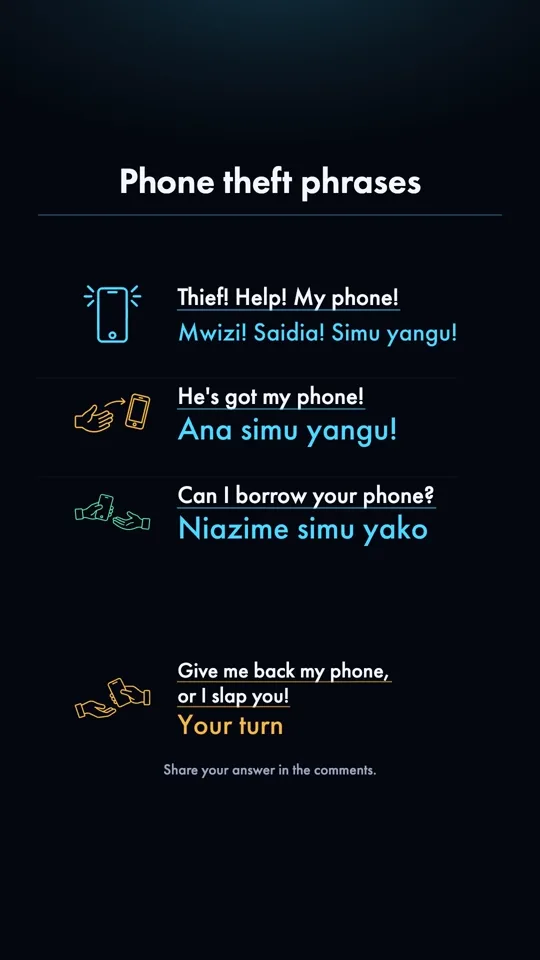
Hii ni simu yangu.
This is my phone.
Safari yangu ilikuwa nzuri.
My journey was good.
Chai yangu haina sukari.
My tea has no sugar.
Kazi yangu inaanza asubuhi.
My work starts in the morning.
Nimesahau kalamu yangu.
I’ve forgotten my pen.
Haya ni maji yangu.
This is my water.


