enda
verb
to go.
The infinitive is kwenda, to go.

Forms
- kwenda
- infinitive; to go
Origins
Enda is inherited Bantu vocabulary. It traces to Proto-Sabaki -enda, from Proto-Bantu -gènda, with cognates across the family: Ngazidja Comorian -enɗa, Giryama -enda, Rwanda-Rundi -gēnda, and Zulu -enda.
Sources4
Charles Sacleux, Grammaire des dialectes Swahilis (Paris: Procure des PP. du Saint-Esprit, 1909), PDF page 247.
Explains kwenda and related historical verb forms. Historical evidence; not a survey of current Kenyan speech.
A. C. Madan, Swahili-English Dictionary (Oxford: Clarendon Press, 1903), PDF page 86.
Contains the historical discussion of enda. The retained OCR is degraded; the university glossary and grammar support the published gloss and infinitive.
University of Kansas Open Language Resource Center, University of Kansas Kiswahili Glossary (University of Kansas Open Language Resource Center), enda glossary rows.
Gives -enda as “to go”.
- enda (Wiktionary)
Traces enda to Proto-Sabaki *-enda, from Proto-Bantu *-gènda, and lists Bantu cognates.
Examples
Unaenda wapi?
Where are you going?
Ninaenda Mombasa.
I’m going to Mombasa.
Tutaenda pamoja.
We’ll go together.
Nilienda sokoni jana.
I went to the market yesterday.
Twende tukanywe chai.
Let’s go and have tea.
Unaweza kwenda sasa.
You can go now.
Ninataka kwenda nyumbani.
I want to go home.
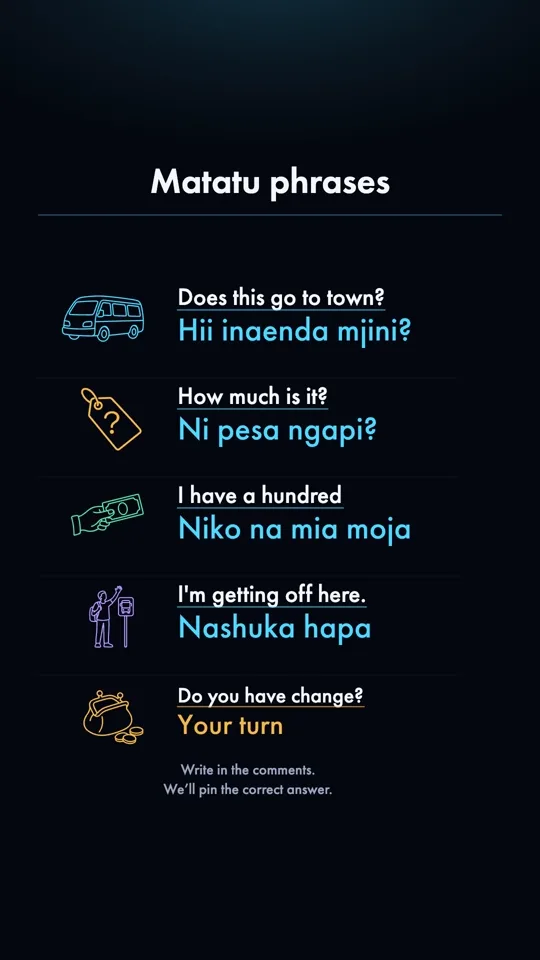
Basi hili linaenda wapi?
Where does this bus go?
Tafadhali nenda polepole.
Please go slowly.


