mwizi
noun
thief.
Use mwizi for one thief and wezi for more than one.
Forms
- wezi
- plural · thieves.
Origins
Mwizi is inherited Bantu vocabulary, built from m- plus -iba, “to steal,” plus the agent ending -i: literally, “one who steals.” It traces to Proto-Bantu *mʊ̀jíbì.
Sources5
Martin Haspelmath and Uri Tadmor (editors), World Loanword Database: Swahili (Max Planck Digital Library, 2009), wold-master/cldf/forms.csv row 57415.
Records noun classes 1/2.
Mzee Morino Tsuneo and Nassor Nakazima Hisasi (editors), ILCAA online lexicon: A dictionary of the Swahili language (Tokyo University of Foreign Studies, ILCAA, 1990–1997), mwizi; [C02].
Documents thief and plural wezi.
Charles Sacleux, Grammaire des dialectes swahilis (Paris: Procure des Pères du Saint-Esprit, 1909), PDF page 242.
Documents thief and plural wezi.
Edward Steere, A Handbook of the Swahili Language as Spoken at Zanzibar (London: Society for Promoting Christian Knowledge, 1884), PDF page 383.
Documents thief and plural wezi.
- mwizi (Wiktionary)
Derives mwizi from Proto-Bantu *mʊ̀jíbì (m- + -iba + agent -i), cognate with Rwanda-Rundi umwibyi.
Examples
Kuna wezi hapa, shika begi lako.
There are thieves here, hold onto your bag.
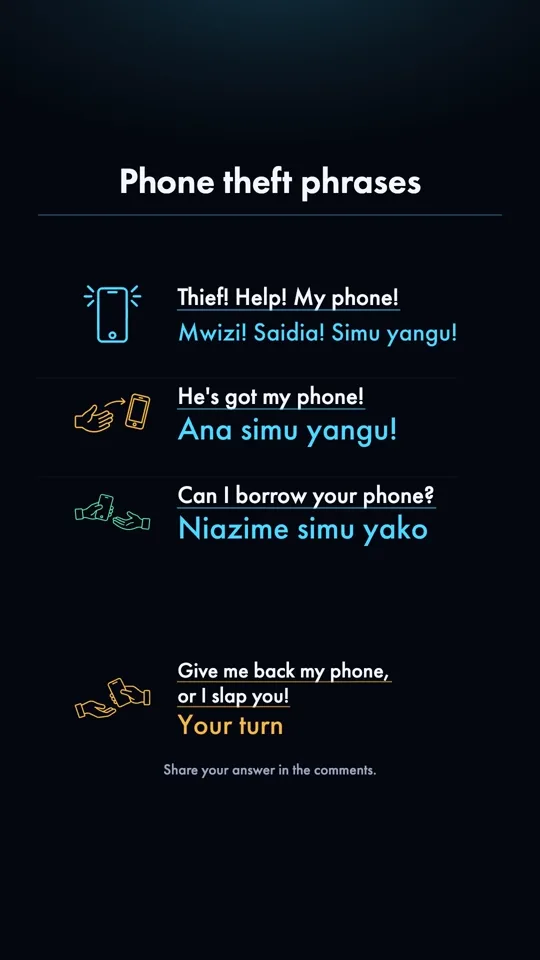
Mwizi ameiba simu yangu.
A thief has stolen my phone.
Jihadhari na wezi sokoni.
Watch out for thieves at the market.
Nilimwona mwizi akikimbia.
I saw the thief running away.
Polisi walimkamata mwizi.
The police caught the thief.
Mwizi huyo alichukua pochi tu.
That thief only took the wallet.
Sio kila mtu ni mwizi.
Not everyone is a thief.
Wezi hupenda sehemu zenye watu wengi.
Thieves like crowded places.
Tulitoa taarifa kuhusu mwizi kwa polisi.
We reported the thief to the police.


