saa
noun
hour.
Swahili clock hours count from about six: saa sita is noon or midnight.
Also clock; watch.
Origins
Its earlier history is still under review.
Sources5
Martin Haspelmath and Uri Tadmor (editors), World Loanword Database: Swahili (Max Planck Digital Library, 2009), wold-master/raw/db/unit.csv row 52419.
Records hour, clock, and watch.
Charles Sacleux, Grammaire des dialectes swahilis (Paris: Procure des Pères du Saint-Esprit, 1909), PDF page 308.
Describes hours, clock time, and Swahili time reckoning.
A. C. Madan, Swahili-English Dictionary (Oxford: Clarendon Press, 1903), PDF page 356.
Documents hours and clock time.
Edward Steere, A Handbook of the Swahili Language as Spoken at Zanzibar (London: Society for Promoting Christian Knowledge, 1884), PDF page 408.
Describes hours, clock time, and Swahili time reckoning.
University of Kansas Open Language Resource Center, University of Kansas Kiswahili Glossary (University of Kansas), saa glossary rows.
Documents hours and clock time.
Examples
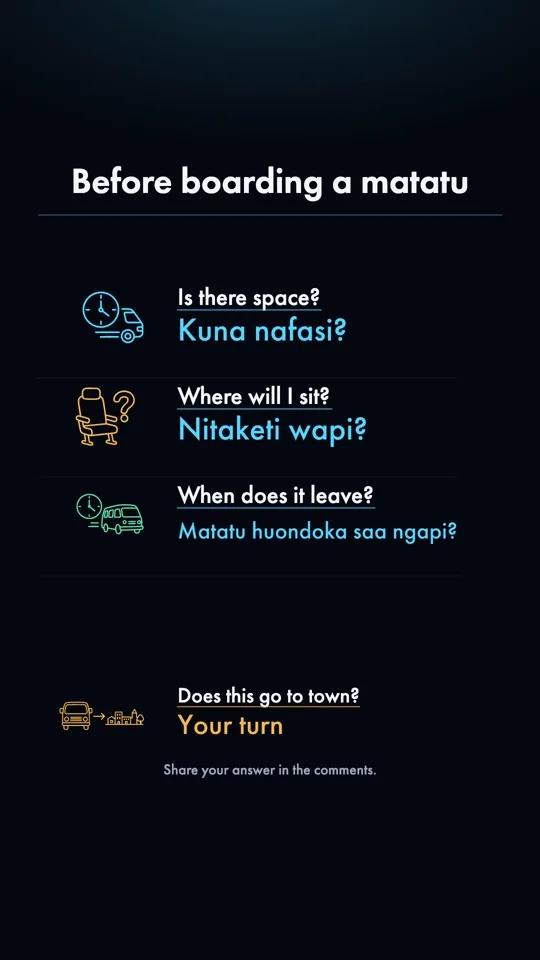
Matatu huondoka saa ngapi?
What time does the matatu leave?
Ni saa ngapi sasa?
What time is it now?
Tutakutana saa nne asubuhi.
We'll meet at ten in the morning.
Safari inachukua saa mbili.
The trip takes two hours.
Nimesubiri kwa saa moja.
I've been waiting for an hour.
Duka hufungwa saa kumi na mbili jioni.
The shop closes at six in the evening.
Nitakupigia simu baada ya saa moja.
I'll call you in an hour.
Ndege inatua saa saba mchana.
The plane lands at one in the afternoon.
Kila saa kuna matatu.
There's a matatu every hour.


