salama
adjective; adverb
safe; safely.
Use salama for a safe state or after a verb: watoto wako salama, “the children are safe”; fika salama, “arrive safely”.
Also safely; without harm. (adverb)
Use after an action, as in nimefika salama, “I have arrived safely”.
Examples
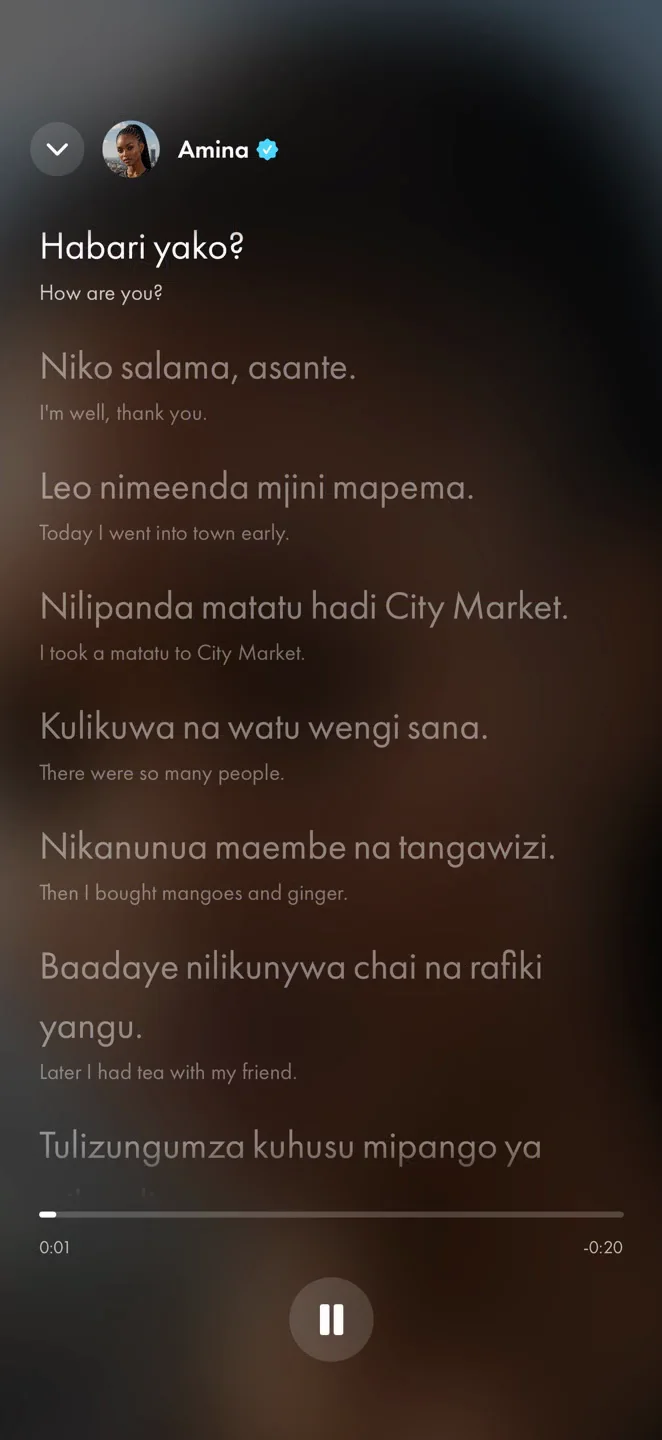
Nimefika salama.
I have arrived safely.
Fika salama.
Arrive safely.
Lala salama.
Sleep well.
Tumerudi salama.
We have returned safely.
Watoto wako salama.
The children are safe.
Mahali hapa ni salama.
This place is safe.
Ninahisi salama hapa.
I feel safe here.
Origins
Salama comes from an Arabic family of words for peace and well-being, including سَلَٰم (salām, “peace”). Its older Swahili range includes safety, sound health and peace.
Sources5
Thilo Schadeberg; editors Martin Haspelmath and Uri Tadmor, World Loanword Database CLDF: Swahili vocabulary (Max Planck Institute for Evolutionary Anthropology / Lexibank, 2009), forms.csv row 54922; ID Swahili-20-14-1.
Records salama as peace/safety in pre-modern Swahili.
Thilo Schadeberg; editors Martin Haspelmath and Uri Tadmor, World Loanword Database CLDF: borrowing records (Max Planck Institute for Evolutionary Anthropology / Lexibank, 2009), borrowings.csv row 8391; ID 8390.
Identifies Arabic salām and salāma(t), peace and well-being, as source words.
Kais Dukes / Quranic Arabic Corpus, University of Leeds, Quran Dictionary: sīn lām mīm (University of Leeds / Quranic Arabic Corpus, 2009–2017), nominal lemma list; 6:54:7.
Supplies the Arabic nominal form سَلَٰم with peace glosses; the Swahili relationship comes from WOLD.
Edward Steere, A Handbook of the Swahili Language as Spoken at Zanzibar (Society for Promoting Christian Knowledge, 1884), 379 (PDF/page 409).
Records salama as safe/safety, and the related salamu forms for safety and peace.
University of Kansas Open Language Resource Center, Kiswahili Glossary (University of Kansas, undated), table rows: salama.
Supplies safe/peaceful senses and Lala salama, sleep well.